


The launch of the HBCU History and Culture Access Consortium (HCAC) Digital Archive marks more than the completion of a digital platform. It represents an ongoing experiment in collaborative digital public history practice: one that asks what it means to build digital archival and public history infrastructures ethically, collaboratively, and with accountability to the communities whose histories those infrastructures seek to represent.
Developed through a collaboration between Historically Black Colleges and Universities (HBCUs), the Roy Rosenzweig Center for History and New Media at George Mason University, and led by the Smithsonian National Museum of African American History and Culture, the HCAC project emerged from a recognition that Black archival/museum histories in the United States are both extraordinarily rich and structurally vulnerable. Many HBCU archives and museums preserve materials indispensable to understanding Black intellectual, cultural, political, and social life in the United States, yet these collections have historically existed within unequal systems of preservation funding, digitization capacity, cataloging infrastructure, and institutional visibility.
Digital public history projects often present themselves as acts of access. But access alone is not enough. The question is not simply whether histories become digitally available, but how they become available, through whose labor, according to whose descriptive frameworks, and with what acknowledgment of power.
Working on HCAC repeatedly reminded us that there is no such thing as “neutral” data. Scholars in archival studies, information science, and Black digital humanities have long demonstrated that systems of classification and description are shaped by institutional histories, structures of power, and culturally specific assumptions about knowledge organization. The categories we create, the language we choose, the stories we foreground, and even the search structures we build all shape how users encounter the past. For example, one of the major technical inputs in the HCAC project is how we entered historical texts, art, and objects from HBCU collections into the digital platform. This required us to design a metadata schema that specifically met the needs of a Black historical archive but also make that metadata useful for a broad public.
Metadata is interpretive infrastructure. As scholars such as Hope A. Olson, Safiya Umoja Noble, and Ruha Benjamin have argued in different ways, systems of information organization and technological infrastructure are never simply technical or objective systems; they encode social priorities, exclusions, and hierarchies. Metadata therefore determines not only what can be found, but also what remains obscured, whose histories appear legible, and what relationships become visible within digital systems.
This becomes particularly important when working with Black archival collections that have historically been marginalized, under-described, misidentified, or interpreted through institutional vocabularies that flatten community-specific meanings and histories. Standardized metadata structures often privilege consistency and interoperability, but in doing so they can also erase local knowledge systems, institutional memory, and culturally specific forms of description.
HCAC therefore required us to think carefully about what collaborative metadata practice might look like. Rather than treating archival description as a purely technical exercise, the project approached metadata creation as an interpretive and relational process. HBCU archivists, curators, faculty, digital humanities practitioners were not simply “content providers” feeding materials into a centralized system. Their knowledge fundamentally shaped how collections were organized, contextualized, and made publicly meaningful.
In practice, this often meant embracing complexity rather than eliminating it. It meant recognizing that institutional histories are uneven, to be comfortable with archival silences and foregrounding them, and that community knowledge frequently exceeds the descriptive limits of controlled vocabularies. It also meant acknowledging that digital public history work is built through relationships: through conversation, trust, negotiation, revision (many times over), and shared stewardship.
The project was therefore deeply informed by frameworks such as Michelle Caswell and Marika Cifor’s concept of “radical empathy,” which asks archivists and practitioners to move beyond extractive or supposedly neutral models of stewardship toward approaches grounded in accountability, care, affect, and responsibility. Radical empathy, in this context, is both an ethical posture but also generative of the methodology.
The HCAC project also speaks directly to broader conversations within Black Digital Humanities about the relationship between race, archives, technology, and historical representation. Black Digital Humanities scholarship has insisted that the database, the metadata schema, and the search algorithm are not delivery mechanisms for history, but they shape what we learn and how we learn history. Further, scholars in the field have demonstrated how databases, metadata standards, search systems, digitization priorities, and archival taxonomies are shaped by histories of exclusion, racialization, and institutional power. These thoughts are foundational to how we approached HCAC.
Scholars such as Jessica Marie Johnson have argued that Black digital practice requires more than the digitization of Black historical materials. It demands critical attention to how Black life becomes translated into data, how archives structure visibility and absence, and how digital projects might resist reproducing the epistemic violences embedded within traditional systems of knowledge organization. Black digital humanities, in this sense, are not simply about increasing access to Black histories. It is also about questioning how historical knowledge itself is structured and how digital systems might better account for community memory, lived experience, and forms of knowledge historically excluded from institutional archives.
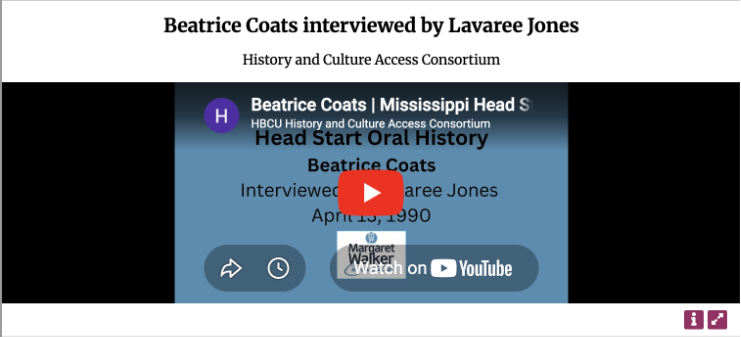
In this sense, HCAC aligns with broader interventions in Black Digital Humanities and critical race studies that call for the reimagining of digital infrastructures themselves, rather than simply diversifying the content housed within existing systems. The project contributes to these conversations by positioning HBCU archives not as marginal additions to dominant archival narratives, but as foundational sites of Black intellectual production, historical preservation, and community stewardship. In doing so, HCAC foregrounds the histories of labor that sustain Black archives: the work of librarians, archivists, faculty, students, and local communities who have preserved these collections despite longstanding structural inequities in funding, institutional support, and digitization infrastructure.
Importantly, HCAC also attempts to model what a more community-centered Black digital humanities practice might look like in institutional collaboration. Rather than extracting materials from partner institutions into a centralized digital repository detached from local contexts, the project emphasizes collaboration, interpretive partnership, and shared authority throughout processes of selection, digitization, metadata creation, curation, and public interpretation that are led by the HBCUs. This approach recognizes that the histories preserved within HBCU collections cannot be meaningfully separated from the communities and institutional histories that produced and sustained them.
Digital public history projects frequently celebrate scale, efficiency, and technological innovation. Yet projects working with marginalized histories must also prioritize slowness, listening, reciprocity, and reflexivity. Community collaboration cannot be reduced to consultation after the fact. It must shape the project from the beginning: from selection and digitization to metadata creation, interface design, interpretation, and long-term stewardship. To this end, we have created a section called “Collection Stories” where HBCU partners can provide interpretive analyses of their collections.
HCAC also revealed the importance of designing digital systems that allow for multiplicity rather than singular authority. Black histories within archives and museums are not monolithic, and no single institutional framework can adequately contain the diversity of experiences, practices, and epistemologies represented across HBCU collections. The archive is not simply a repository of objects and documents. It is also a repository of relationships, memory, institutional struggle, intellectual labor, and community care.
As digital humanities and digital public history continue to expand, projects like HCAC remind us that the future of digital practice cannot be measured solely through technological sophistication. The ethical and intellectual stakes of digital work lie equally in how projects are built, whose expertise is recognized, and whether communities retain meaningful interpretive presence within the systems that represent their histories.
The HCAC Digital Archive is therefore not an endpoint. It is an invitation to continue thinking critically about collaboration, archival power, metadata, and public history practice. If digital public history seeks to democratize access to the past, then it must also confront the structures through which historical knowledge is organized, described, and made visible in the present.
References:
Benjamin, Ruha. Race After Technology: Abolitionist Tools for the New Jim Code. Cambridge: Polity Press, 2019.
Caswell, Michelle, and Marika Cifor. “From Human Rights to Feminist Ethics: Radical Empathy in the Archives.” Archivaria 81 (Spring 2016): 23–43.
Johnson, Jessica Marie. 2018. “Markup Bodies Black [Life] Studies and Slavery [Death] Studies at the Digital Crossroads.” Social Text 36 (4): 57–79.
Noble, Safiya Umoja. Algorithms of Oppression: How Search Engines Reinforce Racism. New York: New York University Press, 2018.
Olson, Hope A. The Power to Name: Locating the Limits of Subject Representation in Libraries. Dordrecht: Kluwer Academic Publishers, 2002.